
Adsorption in Core+
The Role of Adsorption in Water Treatment
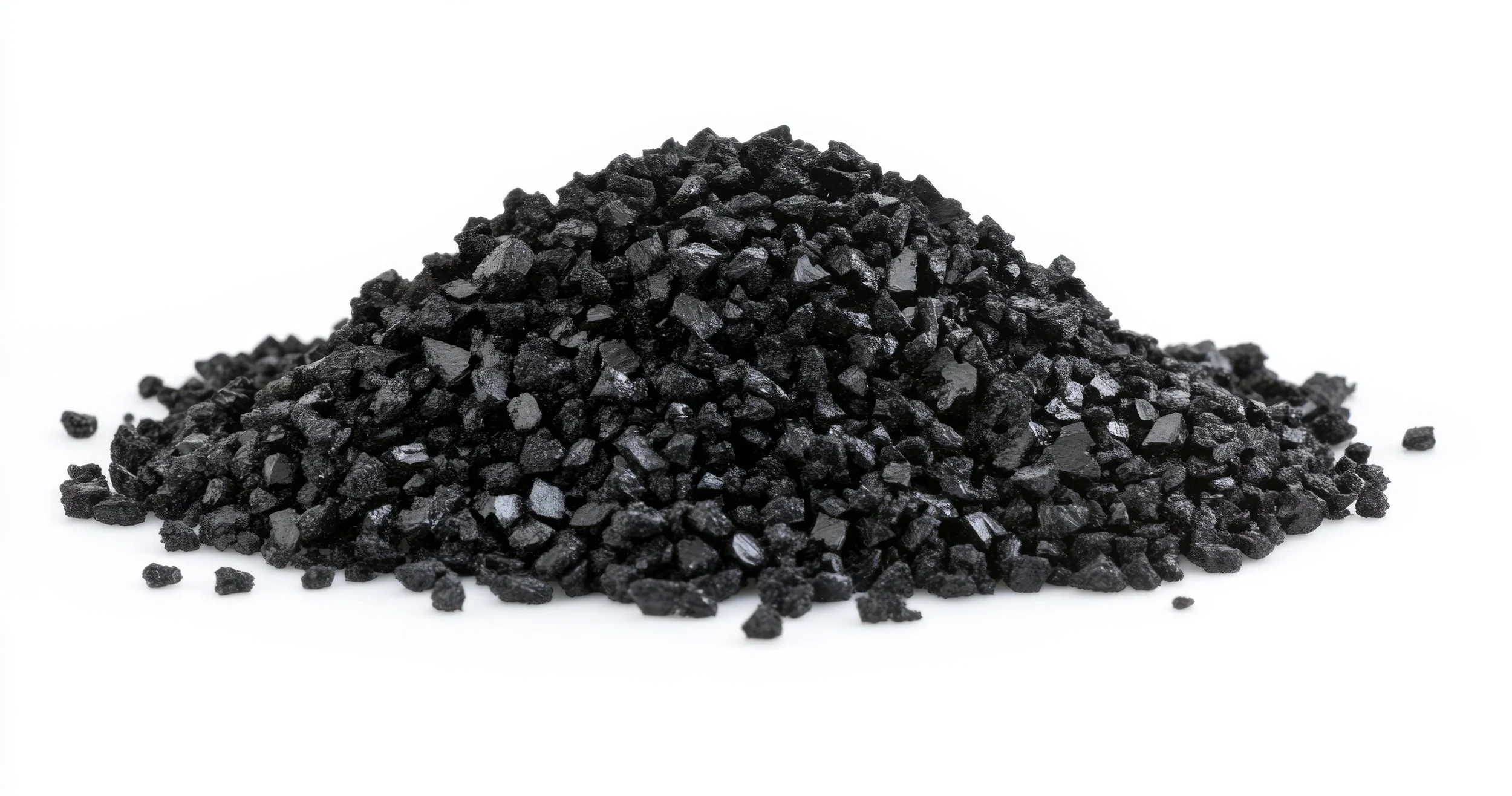
Granular Activated Carbon (GAC) has earned its place as a workhorse technology for water purification. It is a highly porous media with extremely high internal surface area, made from activating materials like wood, coal, rice husks, and others. This gives GAC capacity to attract and hold contaminants. Water contaminants adhere to its surface via adsorption, which is driven mainly by physical forces (van der Waals attractions) between the surface of the GAC and the contaminant molecules.
Activated carbon’s pore structure spans a range of sizes which determine the type of contaminants that can be captured.
Micropores (<2nm): Very small pores, providing majority of surface area. Ideal traps for small organic molecules
Mesopores (2nm - 50nm): Mid-sized pores that create channels within the carbon particle, accommodating larger molecules like perfluoroalkyl substances, PFAS
Macropores (>50nm): Larger pores crucial for fluid transport, allowing water to flow through the carbon granule and deliver contaminants to the smaller pores effectively
The activation process imparts various functional groups on the granular activated carbon’s surface
During activating, the GAC surface gains various functional groups that can impart slight polarity or charge. These can influence adsorption via electrostatic attraction between the functional group and any oppositely charged contaminant molecules. The remainder of the GAC surface is hydrophobic and will preferentially attract hydrophobic organic pollutants such as perfluorooctanoic acid (PFOA) and perfluorooctanesulfonic acid (PFOS), the two major PFAS substances polluting the nation’s water supply.
These attributes make GAC a powerful adsorbent, but it also has its own limitations:
Media replacement and waste: Once GAC is saturated, it must be removed and replaced, either with totally fresh GAC or a mixture of fresh GAC with thermally reactivated GAC that is prepared offsite. Handling spent GAC can be logistically complex and expensive especially when captured contaminants like PFAS are officially considered hazardous and require special disposal. Frequent change-outs mean higher operating costs and generate large waste streams.
Weaker adsorption of certain compounds:Highly water-soluble compounds (including short-chain PFAS) do not attach strongly to normal GAC surfaces, in contrast to large hydrophobic organics.
Diffusion kinetics: If GAC is predominantly microporous, larger molecules such as PFOA and PFOS must diffuse into the smallest pores - possible, a slow process. This can lengthen the time needed to reach full adsorption and leave some of the GAC capacity in the adsorption bed underutilized. When contaminants cannot access all of the GAC’s internal surface area, it results in earlier breakthrough and shorter bed life.
These challenges have become more pronounced as water providers face emerging contaminants and stricter regulations. Disposing of the PFAS-laden GAC also raises serious environmental concerns, fueling interest in regenerable adsorption solutions.
A Complementary Approach: Core+™
At CoreWater Technologies, we saw these issues as an opportunity to innovate with GAC. Our strategy is to reuse GAC, not replace it. We developed Core+™ as a patented composite adsorbent that starts with industry-standard GAC and adds specialized nanoscale coatings to it. This integrated material retains all the familiar characteristics of the base GAC but is imbued with new adsorption functionality provided by the Core+™ coating.
Crucially, Core+™ can be applied to any type of granular activated carbon without altering the base carbon’s manufacturing process. We designed Core+™ to be produced using an add on, wet chemistry processing step. GAC manufacturers do not need to change how they activate the GAC they sell for water treatment. The add-on wet chemical processing that produces Core+ results in a hydrophobic film that securely bonds to the GAC surface. Whether the carbon is coal-based, coconut-based, wood-based, etc., the production of Core+™ integrates seamlessly. This means carbon suppliers can easily upgrade existing product lines by incorporating Core+™ and end users can handle Core+™ just as they would any other GAC product: Core+™ will use the same equipment they use for handling standard GAC.
So, what does the Core+™ coating do?
In broad terms; it is engineered to selectively promote strong hydrophobic interactions with the fluorinated tail of the PFAS molecule. At the same time, it is formulated to reduce ionic and polar bonding that could hinder regeneration.
The net effect is an adsorbent that:
Adsorbs PFAS strongly: Core+™ imparts a higher affinity for PFAS. Conceptually, the additive introduces new active sites or sorptive domains that complement GAC’s porous structure
Is regenerable on-site: A standout feature of Core+™ is that it was designed for in-situ regeneration. The surface chemistry that grabs PFAS from water also releases them when rinsed with a regenerant solution. The contaminants detach into solution, and the Core+™ is ready to resume adsorbing after a final rinse.
Core+™ transforms GAC from a single use or difficult to regenerate medium to a multi-cycle solution. This directly addresses the waste and cost problem: utilities can now reuse their media repeatedly with minimal performance loss. By capturing PFAS in a concentrated regenerant solution, we facilitate their final destruction by separate downstream methods without the Core+™ ever leaving the bed.
It is important to note that the Core+™ adsorbent particle remains, at its core, granular activated carbon. Water treatment engineers working with it will find it behaves similarly in design calculations (bed sizing, flowrates, pressure drop), except they gain the advantage of on-site regeneration. By complementing GAC rather than trying to reinvent it, Core+™ represents practical innovation. We harness fundamental adsorption science described earlier: large surface area, pore sizes and surface chemistry, and push it a step further in a targeted way.
Our approach exemplifies how understanding the fundamentals of adsorption enables smarter solutions. By addressing affinity for PFAS compounds and media reusability, Core+™ extends what GAC can do. As a result, water treatment systems can more readily adapt to modern challenges while relying on the same adsorption foundation that has served the water treatment industry.
Adsorption is and will remain at the core of many water treatment strategies due to its simplicity and effectiveness. By refining adsorption media, we achieve significant improvements and demonstrate value from building on proven fundamentals: a Core+™ bed integrates into existing processes, captures the PFAS molecules that standard GAC normally does, and enables sustainable use through regeneration.
Understanding the roles of pore size, surface area, and surface chemistry has been critical in our development of Core+™. As the water industry moves forward, coupling the old with the new ensures water treatment is more robust, sustainable, and adaptable.